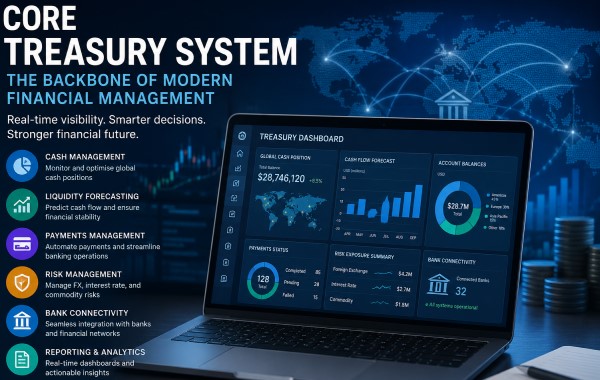
Introduction to Core Treasury System
A Core Treasury System is a centralised financial platform used by organisations to manage cash flow, liquidity, banking operations, investments, and financial risks in real time. It acts as the control centre of corporate treasury functions, giving finance teams complete visibility over global funds and enabling smarter financial decision-making.
In today’s fast-moving global economy, businesses deal with multiple currencies, cross-border transactions, complex banking networks, and fluctuating market risks. Without a structured system in place, managing these operations becomes inefficient and highly risky. This is where a Core Treasury System becomes essential.
It not only streamlines financial operations but also improves accuracy, compliance, and strategic financial planning.
Understanding the Core Treasury System
A Core Treasury System is designed to centralise all treasury-related activities into a single integrated platform. It connects banks, enterprise resource planning (ERP) systems, financial markets, and internal accounting systems to provide real-time financial intelligence.
At its core, the system focuses on three main objectives:
- Managing liquidity efficiently
- Reducing financial risks
- Improving cash visibility across the organisation
Large corporations, multinational companies, and financial institutions rely heavily on such systems to maintain financial stability and operational control.
Core Functions of a Core Treasury System
A Core Treasury System performs several essential financial functions that support daily treasury operations and long-term financial strategy.
Cash Management
Cash management is one of the most important functions of a Core Treasury System. It tracks cash inflows and outflows across all accounts and subsidiaries. This ensures that organisations always know how much liquidity is available at any given time.
It helps companies:
- Consolidate global cash positions
- Reduce idle cash
- Improve working capital efficiency
Liquidity Management
Liquidity management ensures that a business has enough cash available to meet its financial obligations. A Core Treasury System forecasts future cash requirements and helps businesses plan accordingly.
This reduces the risk of cash shortages and ensures smooth business operations even during uncertain market conditions.
Payment Processing
The system automates domestic and international payments, reducing manual errors and delays. It also integrates with banking networks to ensure secure and compliant transactions.
Key benefits include:
- Faster payment execution
- Reduced operational costs
- Improved accuracy in financial transactions
Risk Management
Financial risk is a major concern for global businesses. A Core Treasury System helps monitor and manage risks related to:
- Foreign exchange fluctuations
- Interest rate changes
- Commodity price volatility
By identifying risks early, companies can take preventive actions to protect their financial position.
Bank Relationship Management
Organisations often deal with multiple banks across different countries. The Core Treasury System centralises all banking relationships, making it easier to manage accounts, transactions, and communication with financial institutions.
Financial Reporting and Analytics
The system provides real-time dashboards and detailed financial reports. These insights help finance teams and senior management make informed decisions based on accurate data.
Importance of Core Treasury System in Modern Businesses
In today’s digital economy, financial complexity has increased significantly. Businesses operate across multiple markets, currencies, and regulatory environments. A Core Treasury System plays a vital role in simplifying this complexity.
Real-Time Financial Visibility
One of the biggest advantages is real-time visibility of cash and financial positions. Companies can instantly see where their money is located globally, which helps improve decision-making.
Improved Financial Control
With centralised data and automated processes, organisations gain better control over their financial operations. This reduces dependency on manual spreadsheets and disconnected systems.
Enhanced Efficiency
Automation eliminates repetitive manual tasks such as data entry, reconciliation, and reporting. This allows treasury teams to focus on strategic financial planning instead of operational work.
Better Compliance and Governance
A Core Treasury System ensures compliance with financial regulations by maintaining accurate records and audit trails. This reduces the risk of penalties and financial discrepancies.
Core Treasury System Architecture
The architecture of a Core Treasury System is built to support scalability, integration, and real-time processing.
Data Integration Layer
This layer connects the system with external sources such as banks, ERP systems, and financial markets. It ensures seamless data flow across platforms.
Treasury Processing Engine
This is the core component responsible for executing treasury operations such as payments, cash forecasting, and risk analysis.
Analytics and Reporting Layer
This layer transforms raw financial data into meaningful insights through dashboards, reports, and predictive analytics.
Security and Compliance Layer
Security is critical in financial systems. This layer ensures data protection, user authentication, and compliance with global financial regulations.
Key Benefits of Core Treasury System
Implementing a Core Treasury System offers several strategic advantages for organisations.
Centralised Financial Management
All financial data is stored in one system, eliminating silos and improving transparency across departments.
Reduced Operational Risk
Automation reduces human errors and ensures accurate financial processing, minimising operational risks.
Optimised Cash Utilisation
The system helps companies use their cash more effectively by identifying idle funds and reallocating them efficiently.
Faster Decision-Making
Real-time data and analytics allow finance leaders to make quicker and more informed decisions.
Scalability for Global Operations
As businesses expand internationally, the system adapts easily to support multiple currencies, regulations, and banking systems.
Challenges in Implementing Core Treasury System
Despite its benefits, implementing a Core Treasury System can be complex.
High Implementation Cost
Setting up a fully integrated treasury system requires significant investment in software, infrastructure, and training.
Integration Complexity
Connecting the system with existing ERP platforms and banking systems can be technically challenging.
Change Management
Employees may need time to adapt to new processes and technology, requiring proper training and support.
Data Security Risks
Since the system handles sensitive financial data, strong cybersecurity measures are essential to prevent breaches.
Future of Core Treasury System
The future of Core Treasury Systems is being shaped by advanced technologies such as artificial intelligence, machine learning, and blockchain.
Artificial Intelligence Integration
AI is improving cash forecasting, fraud detection, and financial decision-making by analysing large datasets in real time.
Automation and Smart Workflows
Future systems will automate almost all manual treasury functions, increasing efficiency and reducing human intervention.
Blockchain for Transparency
Blockchain technology may enhance transparency and security in financial transactions by providing immutable records.
Cloud-Based Treasury Systems
Cloud adoption is increasing, allowing organisations to access treasury systems remotely with greater flexibility and lower infrastructure costs.
Conclusion
A Core Treasury System is no longer just a financial tool; it is a strategic necessity for modern businesses. It provides complete control over cash, liquidity, payments, and financial risks while improving efficiency and decision-making.
As global financial markets continue to evolve, organisations that adopt advanced treasury systems will be better positioned to manage uncertainty, optimise resources, and achieve sustainable growth.
In essence, the Core Treasury System serves as the financial backbone of an organisation, ensuring stability, transparency, and strategic financial control in an increasingly complex business environment.